
What makes this ant game different?
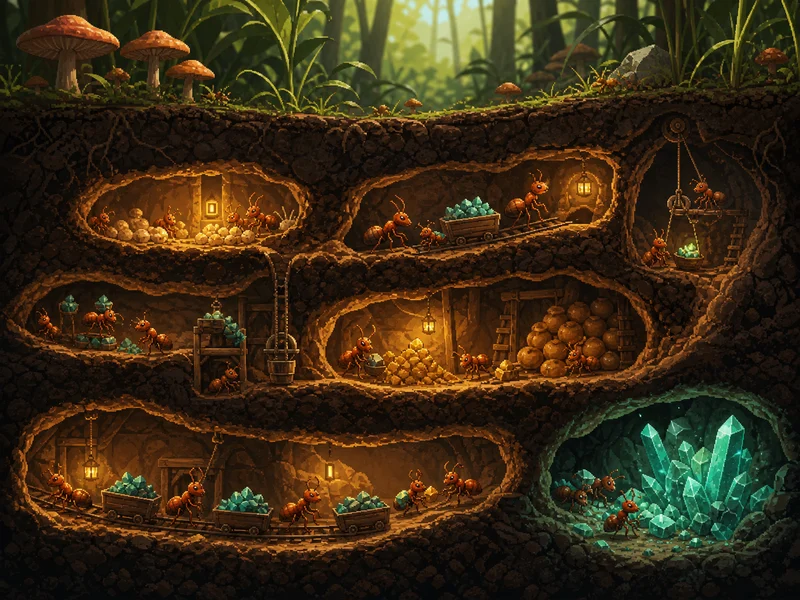
Many incremental games hide their economy behind menus. Ant Colony Incremental Simulation puts the colony itself at the center. Ants, tunnels, mined material, and the flow between parts of the operation give you information. A slowdown is not just a timer becoming longer; it can be a clue that one stage of the colony is no longer keeping up.
Tegel describes the game as an incremental simulation in which you control an ant mining colony. The official itch.io page lists it as an HTML5 Simulation made with Godot and tags it Incremental and Pixel Art. It is currently marked in development.
The core management idea
Think of the colony as a chain rather than a single production button:
access work → extract material → move it through the colony → turn it into usable progress → expand or improve the system
The exact names on screen may evolve, but the management principle is stable. Improving a fast stage does little if the next stage is already overloaded. The best purchase is usually the one that increases the throughput of the whole chain.
This is why watching before buying matters. If workers frequently wait at the same point, travel a long unproductive route, or create material faster than the next visible step can handle it, you have found a candidate bottleneck.
First-session walkthrough
1. Let the colony run untouched
When the game opens, resist the urge to buy immediately. Spend a short period identifying the moving parts and the numbers attached to them. Look for what is being produced, how it reaches its destination, and which resource pays for improvements.
You are establishing a baseline. Without it, a purchase may feel effective simply because the numbers were already rising.
2. Find the limiting stage
Ask a concrete question: what is the colony waiting for right now? It might need more extraction, more capacity, faster movement, or a new unlock. Choose the explanation best supported by what you can see.
If the interface provides tooltips, read them before spending. An upgrade that multiplies a secondary value is not automatically better than a modest improvement to the current constraint.
3. Make one change
Buy or activate a single affordable improvement, then watch the same area again. Did output rise? Did waiting move to a different part of the colony? Did a new option appear?
Changing one variable at a time makes the simulation legible. Buying several upgrades together may be faster in the moment, but it teaches you less about how the economy fits together.
4. Expand only when the existing loop works
Expansion adds opportunity and complexity. Before opening a new area or layer, make sure the colony can support its current workload. A larger inefficient network can progress more slowly than a smaller balanced one.
5. Repeat observation after every unlock
A new system changes the value of old upgrades. Return to the colony view and repeat the baseline check. The bottleneck that mattered five minutes ago may no longer be relevant.
How to compare upgrades
When two purchases compete for the same resource, compare them in this order:
- Does either one fix visible waiting? Prefer the purchase tied to an observed constraint.
- Does it affect the whole production chain? Broad throughput gains often remain useful longer.
- How quickly does it pay back? A cheap improvement can fund the expensive one sooner than saving from a weak baseline.
- Does it unlock a new capability? Unlocks can be more valuable than a small percentage increase, but only if you can use them immediately.
- Will it create a new bottleneck? Doubling extraction may simply overload transport or storage.
Do not confuse the largest number with the largest practical improvement. In a simulation, context decides value.
Active play versus waiting
The game carries the Incremental tag, but that does not prove every form of offline or closed-tab progress. Treat it as an active browser simulation unless the current build explicitly says otherwise.
During an active session, waiting is most useful when it confirms a diagnosis. If the colony needs time to accumulate a purchase, watch whether the same stage remains limiting. If progress stalls entirely, re-check the interface for an affordable action or a capacity limit rather than assuming the intended answer is a long idle period.
Common mistakes
Buying every highlighted option
A notification means something is available, not that it is the best use of resources. Preserve the ability to respond to the next constraint.
Spending to zero
An empty reserve can turn a small misread into a long recovery. Keeping a buffer is especially useful in an unfinished build whose balance may shift.
Expanding before stabilizing production
New space looks like progress, but expansion can increase travel and demand. Improve the existing chain first when its weaknesses are obvious.
Assuming the current balance is final
The official page marks the project in development. A dominant strategy may disappear after an update, so learn the system rather than memorizing one price sequence.
Treating an old guide as a control manual
Controls and button labels are not documented on the public page. Follow the current build's prompts instead of trusting an unverified key list.
Who will enjoy it?
Ant Colony Incremental Simulation is a promising fit for players who like watching systems operate, diagnosing production chains, and improving a small organization step by step. It may be less satisfying if you want a finished campaign, a fully documented optimization wiki, or a purely passive counter that progresses without observation.
The pixel-art colony theme also gives the economy a useful sense of place. Even when the correct decision is numerical, the movement of the colony helps explain why it works.
Development and AI disclosure
Tegel explicitly discloses using AI for coding support while building the project. The developer says the concept, design, and all artwork were made by them. That distinction matters here: the game page is marked AI Assisted for code, not presented as a package of generated art.
Because the project is unfinished, this guide focuses on durable management reasoning and clearly attributed facts. It avoids promising specific late-game systems that the developer has not documented publicly.
FAQ
Where can I play Ant Colony Incremental Simulation?
Open the official Tegel itch.io page, or use the play button on the FreshArcade game hub.
Is it free?
The current HTML5 build is listed under itch.io's free Simulation games. The page also offers an optional way to support the developer.
Is there a download?
The official project information lists HTML5 as its platform. No desktop build is advertised on the page at the time of this update.
Does it have offline progress?
The public description does not confirm offline progress. Check the live build for any current save or offline-earnings explanation.
Who made the game?
Ant Colony Incremental Simulation is developed by Tegel in Godot.
What should I do when progress slows?
Watch the colony and identify the first stage that cannot keep up. Save for or buy an improvement that addresses that constraint, then measure the result before making another change.
Source checked against Tegel's official itch.io project page on July 17, 2026.