
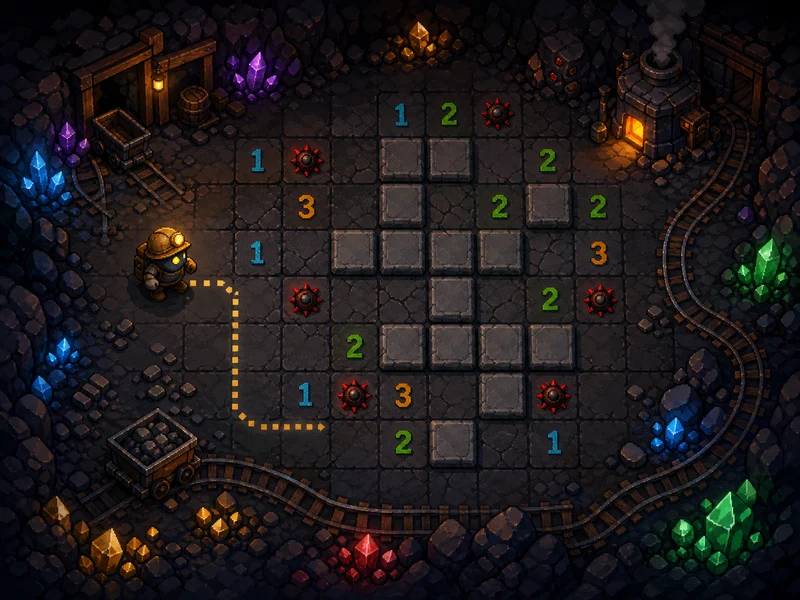
The essential Minesweeper rule
Every revealed number counts explosives in the eight neighboring cells, including diagonals. A `1` means exactly one of those eight spaces contains an explosive. A `3` means three do.
Two deductions solve most safe positions:
- If a number already touches the correct number of confirmed explosives, all its other covered neighbors are safe.
- If the number of still-covered neighbors equals the number of explosives not yet accounted for, every one of those covered neighbors is dangerous.
For example, imagine a revealed `2` touching three covered cells. If one of those cells is already confirmed as explosive, exactly one of the remaining two is dangerous. You cannot choose safely from that clue alone. Look for an overlapping number that touches only one of those two cells; combined clues may resolve the ambiguity.
Why overlap matters
Dynamine is not played on a neat rectangular board that waits politely for you. You are moving through a mine, so information appears along irregular edges. A single number may be ambiguous, while two neighboring numbers constrain the same hidden area in different ways.
Before guessing, compare their neighborhoods. If a `1` and a `2` share two covered cells but the `2` touches one additional covered cell, that extra cell may be forced to contain the second explosive. Once marked, the shared cells can become safe.
This subset reasoning is the difference between digging randomly and mining deliberately.
First-session walkthrough
1. Read the nearest complete clues
Begin where revealed numbers have the fewest covered neighbors. A `1` beside one covered cell is certain. A `2` beside two covered cells is certain. Resolve those forced moves before extending into a wide wall of unknown ground.
2. Separate marking from digging
Use the current build's prompts to learn how it distinguishes a confirmed explosive from a dig action. The itch.io page documents keyboard, mouse, and gamepad support with configurable controls, but not one permanent key map.
Mark only cells proven dangerous. Treating a suspicion as a fact corrupts every neighboring calculation.
3. Collect and sell safe ore
Digging can reveal empty ground, open areas, or minerals. Valuables can be sold for money, which funds upgrades and special tools. Early on, prioritize reliable safe excavation over reaching distant shiny ore through unresolved clues.
4. Choose an upgrade that removes friction
Ask what currently wastes the most time: breaking common material, carrying what you find, traversing known tunnels, or processing value. Buy against that observed constraint rather than following the highest price.
5. Search methodically for the elevator
Each layer has an elevator leading deeper. The official description says deeper layers contain more valuable minerals and greater danger. Explore in a coherent direction and maintain a route back instead of creating scattered tunnels that are difficult to read and travel.
A safe decision routine
Before every uncertain dig:
- Count all eight neighbors of the relevant number.
- Count confirmed explosives, not merely covered cells.
- Subtract confirmed explosives from the clue.
- Compare the remainder with the still-covered neighbors.
- Check an overlapping clue before concluding that a guess is necessary.
If the information remains ambiguous, expand from a different solved edge. A safe move elsewhere can reveal the clue that resolves this area later.
Building an efficient mine
Plan routes, not just openings
As the cave grows, distance becomes an economic cost. Minecart tracks exist to improve movement through a large network. A useful rail line connects places you revisit: a productive excavation frontier, processing area, selling point, or route toward the elevator.
Do not lay an elaborate branch to a location you will visit once. Build around repeated travel.
Process ore when the value justifies it
Furnaces increase the value of raw resources. Processing is attractive, but it can introduce waiting or extra handling. Compare the added sale value with the effort and time required. Raw selling may still make sense when you need a near-term tool; processing becomes stronger when throughput can support it.
Upgrade the common action
An improvement applied to a task repeated hundreds of times can outperform a spectacular bonus used rarely. If ordinary digging dominates your session, reducing that friction has compounding value.
Preserve readable clue boundaries
Randomly biting into several walls produces many partial clues and more visual bookkeeping. Completing one informative edge gives you a clearer set of deductions and a safer expansion route.
Risk management
The official page is direct: digging an explosive cell is game over. That makes survival part of the economy. A risky shortcut does not merely cost health; it can erase the value of time invested in the current expedition.
When the mine offers no forced move in one area, leaving it unresolved is often correct. Search for information elsewhere. If every frontier ultimately requires uncertainty, choose based on the largest amount of independent clue information rather than the most tempting ore.
Remember that Dynamine is still in development. Save behavior and death consequences can change between versions, so check the current build instead of relying on an old comment or guide.
Common mistakes
Reading only orthogonal neighbors
Diagonals count. Missing one diagonal cell invalidates the clue.
Marking a cell because it “looks likely”
A marker is useful only when it records a deduction. Speculative flags poison later reasoning.
Solving one number in isolation
Ambiguous clues often become certain when compared with an overlapping neighbor.
Chasing valuable ore through unsafe ground
Visible value does not make a cell safe. Solve the route first.
Buying upgrades without identifying the bottleneck
Money spent on a rarely used tool cannot improve the task consuming most of your time.
Creating a maze of disconnected tunnels
Scattered exploration increases travel and makes clue boundaries harder to interpret. Use deliberate fronts and connect repeated destinations.
What progression adds to Minesweeper
Classic Minesweeper ends when the board is solved or a mine is hit. Dynamine gives each deduction an economic consequence. A safe cell may produce ore; a completed route may reveal the elevator; accumulated money changes how quickly you can excavate the next region.
Procedural generation also creates a broader sense of place. The official description mentions different biomes and resources, abandoned structures, and occasional special treasures. Those features reward exploration, while the explosive rules keep expansion from becoming mindless grinding.
This hybrid structure explains why the game can feel slower than a puzzle board and more dangerous than a typical incremental game. Efficiency and certainty have to coexist.
Availability and current version
Dynamine is in development and playable in the browser. The itch.io page also offers name-your-own-price demo downloads for Windows, macOS, and Linux. It is made with Godot and supports keyboard, mouse, and gamepad input with configurable controls.
HexagonNico describes the average session as about half an hour, though the procedural world and progression can support longer play. The project page points to a Steam version in development as well.
FAQ
Where can I play Dynamine?
Use HexagonNico's official itch.io page, or open it through the FreshArcade Dynamine hub.
What do the numbers mean?
Each number is the exact count of explosive cells among its eight adjacent spaces, including diagonals.
What happens when I hit an explosive?
The official description says the run ends. Verify the precise current penalty in the live build because the game remains in development.
How do I reach the next layer?
Find the elevator generated in the current layer. Deeper layers offer more valuable minerals and greater danger.
Why build minecart tracks?
They reduce travel friction as the procedurally generated cave grows. Prioritize routes between destinations you revisit.
What are furnaces for?
Furnaces process raw ore to increase its value before sale.
Is there a downloadable version?
Yes. The itch.io page offers demo builds for Windows, macOS, and Linux in addition to HTML5 browser play.
Source checked against HexagonNico's official Dynamine page and current project information on July 17, 2026.